
Get Healthy!
- Posted December 19, 2025
Miracle Surgery Saves 2-Year-Old Boy With Broken Neck, Severed Spinal Cord
Two-year-old German boy Oliver Staub lay in a Mexico City hospital bed awaiting death.
An armored car going 70 mph had slammed into his family’s minivan during a vacation in Mexico.
The crash disconnected Oliver’s head from his spine, resulting in the severing of his spinal cord.
Doctors told his parents that Oliver’s neck was broken, he was a quadriplegic, he was brain-dead, and he would die within days.
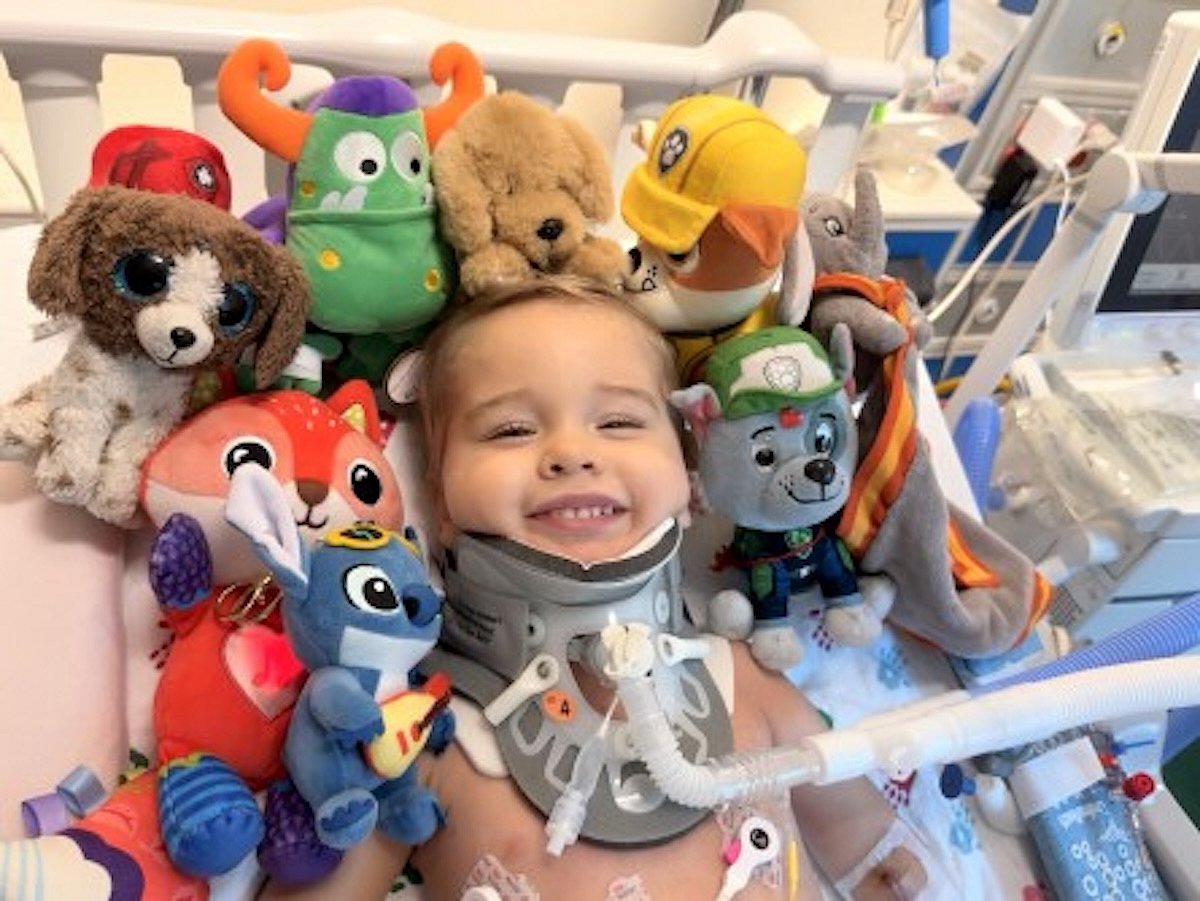
By mid-October, Oliver was talking, laughing, smiling, moving his fingers and toes and starting to breathe on his own, thanks to miracle surgeries performed at the University of Chicago Medicine Comer Children’s Hospital.
These surgeries fused Oliver’s broken neck and reattached his spinal cord.
“To see someone survive an injury like this? Nothing like this has ever been reported in neurosurgery or spinal cord injuries,” Dr. Mohamad Bydon, chair of neurological surgery at UChicago Medicine, said in a news release.
“We didn’t think he’d ever be able to move, and now he’s moving all four limbs,” Bydon said. “This is a unique and special case. It's beyond our wildest expectations."
As Oliver lay in his Mexico City hospital bed after the April 17 accident, with everyone expecting his imminent death, the boy instead began to show signs of recovery.
His parents, Stefan and Laura, realized that his eyes were following them when they were in the room. His doctors agreed that this was a sign of brain function, and kept his life-sustaining ventilator on.
“It was at that moment that I thought, ‘We have a reason to fight,’ ” Laura Staub said in a news release. “My son was there.”
After he’d recovered as much as he could, Oliver was moved to his grandparents’ home hours away, near Morelia, Mexico. He wore a neck collar and vest to stabilize his head, which remained unconnected to his body via the spine or spinal cord.
Oliver survived two months there, his parents and a day nurse tending to his ventilator.
Bydon said this is astounding, and it’s unlikely someone with a broken neck and severed spinal cord could survive at all, much less under home care from his parents.
“If Oliver’s parents and caretakers had made one wrong move in those two months, it could have resulted in death,” Bydon said.
Searching for potential treatments for Oliver, his parents contacted Bydon after learning of his groundbreaking stem cell therapy research.
Most doctors had told them that the surgery and the travel involved would be too risky, but Bydon said the fact Oliver had survived this long provided some measure of hope.
“You should never count out a 2-year-old. They can surprise you,” Bydon said. “But it would require a complex multidisciplinary team, which is where the University of Chicago could help.”
To pay for the travel and surgery, the Staubs reached out to the Toni Kroos Foundation, a charity set up by the former German soccer player to help seriously ill children. The foundation agreed to pay for the surgery and travel.
“We cried and cried. We couldn’t believe it,” Laura said. “None of this would have been possible without Toni Kroos.”
Oliver soon became a top-trending news story in Germany. Strangers from around the world held fundraisers and prayer vigils, sending donations for his medical expenses and words of encouragement.
A medical jet flew Oliver to Chicago in July. A surgical team awaiting his arrival set to work.
The first surgery reconstructed Oliver’s spine, repairing his spinal cord and using titanium rods and screws to reattach the back of his head to his spine.
A second surgery two days later stabilized the front of his spinal cord and repaired a spinal cord herniation.
These were risky surgeries for a 2-year-old, Bydon said. A toddler can’t tolerate blood loss.
“Those first few days after the surgeries were harrowing,” Bydon said. “His heart stopped at one point, and he had swelling in the brain.”
But within five days, Oliver smiled for the first time since the accident. A month later, he was able to grab his mother’s hand, push someone away and recognize the sensation that he needed to urinate.
Most impressively, Oliver can now take breaths on his own, Bydon said.
“We know the spine is communicating with the brain and body again,” Bydon said.
Oliver left the Chicago hospital Aug. 15. His family plans to permanently move to Mexico from Germany, to live near Laura’s family.
Doctors expect that within six months, Oliver will be able to remove his neck brace.
The Staubs plan to return to Chicago this coming spring. Bydon has asked for special approval from the U.S. Food and Drug Administration to use his stem cell therapy to improve Oliver’s physical function, as part of ongoing clinical trials.
“He didn’t promise us a miracle,” Laura said of Bydon, “but he delivered one.”
More information
Stanford Medicine has more on spinal cord injury in children.
SOURCE: University of Chicago Medicine, news release, Oct. 28, 2025


